
 Apple Podcasts

 Spotify

 YouTube
Why Self-Care Won’t Fix Burnout: Cait Donovan on Workplace Stress, Leadership & Mismatch
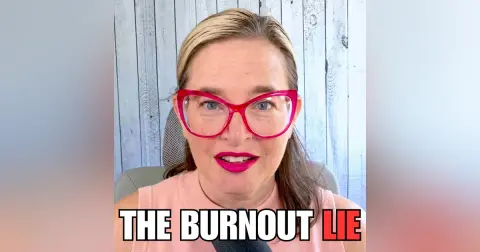
What if burnout isn't a sign that you need to try harder, but a sign that something in your life or workplace simply doesn't fit? In this episode of Hot Habits, host Dr. Tamsin sits down with Caitlin Donovan, burnout expert, keynote speaker, author, and host of FRIED: The Burnout Podcast, to explore the real causes of burnout, chronic stress, workplace culture, conscious leadership, and why self-care alone isn't enough to fix the problem.
You'll get a peek at what most people miss:
* Why burnout is often caused by a mismatch between people, their roles, and workplace systems rather than a lack of resilience
* How childhood experiences, chronic stress, and the nervous system can affect the way we recognize and respond to burnout
* Why listening to basic body signals, like hunger, tiredness, and the need to use the bathroom, can help rebuild self-trust
* How the gap between company values and everyday workplace behaviors can lead to stress, frustration, and employee burnout
* Why leaders and employees need to work together to create healthier workplace cultures without blame, shame, or unrealistic expectations
If you're interested in burnout prevention, stress management, conscious leadership, emotional intelligence, nervous system health, workplace culture, or personal growth, this episode offers a fresh perspective on why working harder isn't always the answer. Sometimes, the most powerful step toward a healthier, happier life is recognizing what isn't working, letting go of self-blame, and finding a better fit.
*Episode highlights:*
Chapters
- 00:00:00 Intro
- 00:00:49 Why burnout is a mismatch problem, not a personal failure
- 00:03:19 Caitlin shares her morning protein coffee habit and why simple routines matter
- 00:05:40 Connecting Chinese medicine, modern science, and the body's response to stress
- 00:10:46 Why removing shame, guilt, and blame is essential to burnout recovery
- 00:13:35 How stress, genetics, and childhood experiences can shape burnout over a lifetime
- 00:18:29 Understanding the connection between childhood stress, brain development, and body awareness
- 00:21:26 The surprisingly simple habit that helps rebuild trust with your body
- 00:24:45 Why burnout looks different in nonprofit organizations and corporate workplaces
- 00:27:43 Why Caitlin uses a middle-out approach to help leaders and employees improve workplace culture
- 00:33:05 Caitlin's practical advice for recognizing mismatches, reducing burnout, and finding a better fit
*A little more about today's guest:*
Caitlin Donovan has h a master's degree in Chinese medicine and a background in biobehavioral health. Caitlin brings together Eastern medicine and modern stress science to explore how our bodies, experiences, and environments shape our well-being. Through her work with organizations across healthcare, finance, technology, and other industries.
https://caitdonovan.com/
I'm *Dr. Tamsin Astor,* and I am neuroscientist who studies habits in teams, relationships and systems. I'm obsessed with one question: which habits are quietly running your life, and which ones could change everything?
I work with founders and leadership teams to identify the invisible defaults driving their culture, their communication, and their results and then we redesign them, from the inside out.
No one shows up as just "the CEO." You're a founder, a colleague, a parent, a partner, a human… often all before lunch. When you only change habits in one role and ignore the others, you get burnout, misalignment, and a culture that feels brittle no matter how good your strategy is.
My work blends neuroscience, habit design, conscious leadership, and relational intelligence — because your relationships are your leadership. Full stop.
Clients usually find me when they're exhausted from putting out the same fires and starting to suspect: this isn't just a strategy problem. It's a human habits problem.
I believe how you live and lead ripples outward: into your team, your family, future generations. My core values are freedom and love, and everything I build is grounded in honest communication, smart systems, and deep care for people.
Underneath it all? Relationships are my north star.
Grab Your Free Personal Energy Audit
If this episode got you thinking about your habits, your capacity, or where your energy is really going, I made something to help you take the next step.
It’s a free video plus a simple download that walks you through a personal energy audit with AI as your guide. It’s designed to help you see what’s working, what’s draining you, and where small shifts could create more ease, focus, and alignment.
Get the free resource here: https://tamsinastor.zoholandingpage.com/hothabits
Looking forward to being here with you next week for another juicy conversation!
Let’s keep the conversation going.
Join my Substack - https://drtamsin.substack.com/
Check out more episodes - https://www.hothabitspodcast.com/
0:00 Forget everything you know about burnout. It's not about resilience. It's not about self-care. Kate Donovan, burnout expert, keynote speaker, and host of the podcast Pride, is here to tell you exactly what it's about and why Just Try Harder might be the exact thing that's keeping you stuck. Join us on Hot Habits with Dr. Tamsin. Your nervous system sets the tone. Your energy speaks before you do. How you show up is the culture. I'm Dr. Tamsin Aster, and this is Hot Habits, conscious leadership in action. Hello, hello, and welcome to Hot Habits with Dr. Tamsin.
0:43 So buckle up. My next guest is going to ruin the word hustle for you forever. And honestly, good. Kate Donovan is a burnout expert, keynote speaker, and the host of FRIED, the burnout podcast, one of the biggest shows out there tackling burnout, leadership, and workplace culture head on. But here's what I love about Kate. Kate doesn't do blame, she doesn't do shame, she doesn't do slap a yoga class on it band-aid. She says burnout isn't a you problem, it's a mismatch problem, an alignment problem. Wrong person, wrong role, wrong system, wrong leadership. And she'll show you exactly where the gears are grinding. Here's where it gets juicy though for me.
1:24 Kate's got a master's degree in Chinese medicine and a background in bio-behavioral health. I trained in Ayurveda as an Ayurvedic health coach. So between the two of us, we've basically got the East meets West map of the body, mind, energy, perhaps systems covered. Kate reads stress and burnout through this ancient medicine layer on top of the hard science. And that's exactly the kind of systems level body first thinking that I just fully geek out on. This isn't going to be any kind of standard add more self-care burnout combo. I met Kate through our mutual friend, Jess Pettit, who was inducted into the National Speakers Hall of Fame recently, this year, this past summer.
2:12 And one of the things that the three of us align on is blunt, straight talking, and a love of color. Look, we both turned up with our red lipstick today. Kate is also the author of The Bounce Back Ability Factor and her new book, Mismatch, Why Good People Burn Out in Good Organizations, drops in October. She's worked everywhere from hospitals to finance to tech, helping leaders build cultures where people don't have to choose between doing great work and staying whole. Kate, welcome to Hot Habits. That was the funnest intro. It's important to me for people to really understand like the epicness of who you are when you come in.
2:55 So thank you. At the start of every hot habits convo, I like to ask my guests to bring a physical, tangible object with them. Something that represents a hot habit in their life as a way of bringing leadership out of the theory and into your everyday reality. So tell me what object did you bring today and why did you choose it? I am a 44-year-old perimenopausal woman. So my hot habit is protein, coffee, whey protein, creatine, soluble fiber, because we also need that. All mixed in with almond milk and cold brew and blended every morning.
3:38 Because if I start my, I feel like if I start my way that, my day that way, then I'm not having to like catch up later. Mm-hmm. If I can get 25 grams of protein in before I do anything else, then I'm already at least a quarter or a fifth of the way there. Yeah. And I haven't even made eggs yet. Well... As somebody who's 50 and in that same boat, I really appreciate it. And what I also love from that from the habit lens is the like, what you're doing is you're reducing the overthinking, right? Yeah. One of the things we know is the more we think about things, the easier it is to think our way out of it or make other choices.
4:18 And, you know, when we can create automations that serve our bigger goal, and not have to think about it and not sort of push that willpower into making it happen. So and I love that you listed all of the different components because I have my creatine here and I've had my collagen coffee already and my high protein breakfast. Yay, this fun period of life. I'm so tired just thinking about it, but the coffee helps. Yes. Awesome. So what I would love to open with is this juicy mashup that you have of Chinese medicine, biobehavioral health and burnout research.
4:58 Because when I first met you, I just was like, I love who you are and how you show up in the world. But when I started having more in-depth conversations with you and listening to your podcast and digging into your writing, I was really struck by the depth that you go into the science to as a way of really helping people understand it and the way that you keep up to date with the science and a comfortable kind of going, nope, the way I've been thinking about this is wrong. The way I've been teaching this is wrong. This is what the new research shows. This is what the new data shows. Yeah. When you think about these threads weaving together, was there a moment that it clicked? Or was this a sort of sneak up on you of the way they all wove together?
5:39 So I did this backwards. People are going to be very confused by this because I have a very atypical path. I did my first two years of undergrad at Boston University. Then I moved to California and did a four-year master's program in Chinese medicine. I did not get a bachelor's degree along the way. I just went straight to a master's. In the UK, this is something you can do. Like that happens, right? In the US, we don't have that. So I have a master's degree with no bachelor's, which most people are spinning their heads right now thinking, well, how did that happen? I moved at that point to Europe. I worked in Europe for 12 years, full-time acupuncture. Moved back to the States, to New Jersey.
6:21 I couldn't get, even though I kept my national US license, I did my CEUs every year. I did all the things I needed to do to keep my license active in the US. I couldn't practice in New Jersey because New Jersey requires that you have a bachelor's degree. so then I thought I was I had just recovered from burnout I was just I had finished writing my first book and I thought you know what there are some things that I don't understand about stress physiology and how stress is affecting the body from the western perspective and this is stuff that didn't even exist when I went to school in 2003 like we were barely barely studying this so right now there's more information I looked at I needed an online program Because I'm not traveling to classes at 40 years old.
7:08 Like, no, no. With 17 year old, 18 year olds, like that's not happening. So I had to find my old BU transcripts, apply to Penn State World Campus, find a program. And when I looked at the program, this is the moment that it clicked. This is the question that you asked. I'm finally getting to the point. Yeah. Amazing. So that clicking. Yep. I'll explain. The clicking was exactly this. I was reading the biobehavioral health program that they offer. And it is basically how stress affects the body through biology, psychology, sociology, genetics and epigenetics, neurology, anthropology and epidemiology.
7:50 So like all the different ways that stress can affect you from And I looked at that and I thought, oh, this is like Western medicine catching up to Eastern medicine systems thinking. Yes. Yes. Yes. Yeah, I find that really fascinating. I've had that a lot with my training in Ayurveda too and the neuroscience and the learning in that one space and then going, hang on, these connect. These people have been talking about this for 6,000 years, but we've only, yeah, that's fascinating.
8:31 So that weaving together... created this sense of explanation and a place for you to do this work in the world. Like, how do you lead with the Chinese medicine? Because I feel like some places, some organizations, some groups of people really only want to hear the West and you sort of can bring in the East, or do you immediately lead with the weaving together? How does that work with the people Hmm. Almost always. Mm hmm. For the majority of people I've spent so long in the world of Eastern medicine, even when I was still at BU, my my my major was biology.
9:18 I was on a premed track, but my minor was Eastern religion. So I've been in this sort of way of thinking and meditating and all of that for a very, very long time. So it's very natural to me. And I also know that even in the acupuncture office, when people are like, yeah, but what's happening in my body? I learned to use Western words to explain it, which there are some people in the acupuncture world who are very unhappy with that. They say it's not honoring the medicine, et cetera. And at the same time, if I can't use the medicine to help someone because they can't understand the verbiage, which I have studied for 20 something years, I shouldn't expect them to understand the verbiage.
10:02 then I'm not helping the people that I can help. So I almost always go Western research science first. And then I sprinkle in a little Chinese medicine. I will say offhanded comments like you said here, like, you know, we've been talking about this in Chinese medicine for a few thousand years, and now we're really glad to have this backed up by a rigorous study. Yeah, yeah. Yeah. And I appreciate that lens. And I think, I mean, what you're really speaking to here, which is sort of leads into my next question is, is figuring out who you're trying to communicate with, right?
10:43 So this sort of this mismatch, right? So if we think of burnout as being a mismatch problem, not a you problem, right? And which is sort of what you're alluding to here is that you need to speak the language of the people you're trying to help. What shifts when a leader actually believes that it's not a you problem, it's a me problem, it's a I'm doing this all wrong and why can't I cope? What I have seen happen, the first thing that happens and the initial reason for Fried the Burnout podcast was an elimination or at least vast decrease in shame, blame, guilt and judgment, self and other. I find it really hard.
11:25 I have seen it be incredibly difficult for people to heal from various things because I've treated everything from fertility to post-stroke to allergies to stress and burnout. I was a general practitioner. I've treated almost anything that you could come up with. Mm-hmm. It is really hard to heal when you are steeped in shame, when you are blaming something, when you are judging yourself or judging somebody else. And it's harder for other people to heal when they are being judged. So if I can help a leader remove some of the judgment, guilt, blame, shame from themselves and gain a sense of compassion, empathy, grace for other people that might be experiencing something similar, then.
12:12 Hmm. Huh. What, what is that ripple effect to do? Yeah. Yeah. Yeah. No, I think it's really interesting that shame piece about like, you know, and I see that with, uh, with people, when I teach conscious leadership, this piece around like the shame of fight flight, you know, fawn, you know, all of these responses of like, you know, rather than it just being like, that's like my body having a hot flush or like, or I'm I had a fart or I had a period like I'm sweating like like, you know, it's your body reacting. And of course, the mind is in it the physiology, we can, you know, go down all those routes. But if you add shame on top of that, it makes the whole thing so much more destructive. Is I think one of the things I think is really interesting as well about burnout and the kind of cycles of it is the cumulative piece.
12:58 Right. How does this look over a lifetime? Right. I think often people have this misconception about, you know, it's like, you know, you had that one thing, you had the divorce, you had the, you know, the job that you lost. The toxic job. Right. Yeah. The toxic job. Right. Right. So. You talk about mismatches as being cumulative, right? Compounding over a lifetime, not just this like one shitty quarter or a particular event. What does that compounding look like in a body day to day? So people can start to think about, is this happening to me and can start becoming aware of it and alert to it. So I don't want to do a day to day. I would rather do a life. Yeah, perfect.
13:39 Because this is a, if we go into the genetics and epigenetics courses from the biobehavioral health degree, one of the things that I learned that made me like, like stop, like, whoa, I've had to refine this research multiple times and read it to be like, is this true? I know that I've been saying this for years, but like, did I really read that? Or did I make this up? And I have gone back to it multiple times because I have a hard time. It sounds like a clickbait article. And so it bothers me a little bit. But if a woman is pregnant with a daughter especially and experiences something extremely stressful during her pregnancy, and that doesn't have to mean stress emotionally.
14:27 It could be, you know, whatever. Any type of stressor, outside stressor. she can pass on an epigenetic change to her daughter that will dampen the number of cortisol receptors that get built in the brain. And so... Yeah, I just I'm taking that on as the parent of two sons and a daughter, the daughter being the youngest and, you know, parenting, being pregnant with my daughter, you know, as my son was coming out of cancer. Yeah. Yes.
15:08 And it's like, this is not anybody. Again, we're in a blameless space. It's not anybody's fault. Right. There's no fault here. This is just life and it just happens. And the epigenetic change exists to help protect the baby from high stress. But what happens is if there's not enough receptors, For the cortisol, you don't hit the upper thresholds that you need for the negative feedback loop for the stress cycle to stop. So you. It just kind of hangs out. So you end up in this chronic kind of low grade chronic stress because it's harder for you to go through the full stress cycle because your response has been slightly dampened.
15:53 So maybe, and men can have this epigenetic change as well. This is not a sex-based or gender-based idea, right? So... You can have a genetic predisposition to processing stress in a way that is not the most beneficial way. So we start with that. That's our first mismatch. Right. Right. Folks, just so you know, epigenetic changes are not super stable. We can change them. Meditation, somatic healing, acupuncture, vibration, sound healing. Those things can help change an epigenetic shift, which is...
16:34 Like Bruce Lipton's work, right? Like the epigenetics is the blueprint, not necessarily the final expression, right? Exactly. All of his research on that. Yeah. Exactly. So this is not like, oh, my God, I had this situation. So now it's a disaster. No, it's just it's just an initial mismatch. And then maybe you're born and your childhood, you experience some trauma, right? The research on this is adverse childhood experiences. And the ACEs. Right, the ACEs, exactly. So if we're looking at ACEs, Right now, the score is to 10. I actually haven't looked at it in a while. I should look again to make sure that's still correct.
17:15 And anything four or above is considered a high ACEs score. And you'll get a four or above if you can say yes. There's only like 10 questions on the thing. It's not, it's like 16 questions. It's a small thing. But it's like, did you have a parent with a mental illness? Did you feel safe in your household? Did you feel like your emotions were met? So it's emotional... Abuse or neglect, physical abuse or neglect, having a parent that was incarcerated, having a parent that was absent in some other way, having a parent that was mentally ill, living in poverty, like la la la la. Right. So all these different things are adverse childhood experiences. And the more you have, the more it affects you long term. folks, don't worry.
17:57 There's a balance. There are such things as positive childhood experience that can buffer out some of these. So you might have a real wacky childhood and be like, I don't feel like that. Cool. You probably had a grandmother or an aunt or a teacher or a mentor that showed up for you in your community and like backlogged your safety net for you, which can happen. And that was super lucky and amazing. So again, it's not like, oh my God, these things happened and now it's a disaster. No. Yeah. It's just another mismatch that can happen that we're now layering on top. The next mismatch that happens is the brain development that results because of ACEs. So adverse childhood experiences, certain period of time in your childhood, your brain is still developing.
18:40 Your brain will develop differently differently. the more ACEs you have. One of the main things that I've seen a correlation for, this is not a randomized controlled trial, this is not a causation, a correlation for, is that people that have high ACEs scores, four and above, also tend to have an underdeveloped insula. And because they have an underdeveloped insula, they have an underdeveloped sense of self. So people get later on in burnout. They're feeling this chronic stress. Things are happening. And they say, oh, you know, they get blamed for ignoring the signs or missing the signs.
19:21 Honey, you didn't miss the signs. You couldn't even feel them. You were not inside your own body. Your interoceptive skills that come mostly from the insula, not only, but mostly from the insula, your interoceptive skills are diminished through no fault of your own. Yeah. And you don't know that they're diminished because nobody talks about interoceptive skills. Yeah. This is a new science. This is fairly new science. Yep. This is 10, 50. I mean, yeah, maybe 20 years they've been talking about it. The last five or 10, there's been a lot more research, but like- So now you're going through life and all of these things are happening to you and you're not responding or taking care of yourself because you don't feel the effects of the bad thing.
20:03 Okay. Wait a minute. I'm interrupting. I'm so sorry. I know it's really annoying when people do that. But here we go. Before you chase a bigger title in a six pack, I want to share a quick word about why ambition might just be cortisol with a calendar. Success is a state, not a symbol. Grab the free video and the worksheet that's in the show notes to build habits around the state of success, not just the symbols. Real success isn't just a title, an income or the abs. It's the capacity to be present for the life that those things are supposed to buy you. Okay, now back to the episode.
20:44 Okay, so I have a question for you because I teach interoceptive awareness with my sort of the inner work of leadership. And, you know, depending on who I'm talking to, sometimes I might say it's like the sort of internal weather report, right? And, you know, and I've got sort of practices around breath work and around like the senses and, you know, the inner senses and the outer senses, right? The inner voice, the inner hearing and all of those pieces. What is your favorite tool for helping people to really start to build that interoceptive awareness once it becomes clear that they have not got that? Are you ready to laugh? Yeah.
21:24 Yes. Always. Always. pee when you need to pee is the number one tool that I use to help people build interoceptive awareness. Oh, you know, I'm laughing about that so much because having been pregnant three times, that was one of the things that I got really good at ignoring. And then, you know, ADHD. That's another thing. Like when you get into the hyper focus, I'd be like, I'd suddenly come out of it and go, wow, I've needed to pee for ages. And I didn't notice it. So I love that. It's super simple, too, and concrete. So the thing about inter, so to me, when I think about interoception, I'm thinking, okay, internal perception, internal sensing.
22:05 Okay. And what does that mean? And that to me means there's chemical perception. interoception. There's physical interoception. There's mechanical interoception. There's right. There's all these different forms of it. There's like chemical is like endocrine and hormonal based interoception. Right. And like mechanical is like bladder. So when your bladder, when it stretches, yeah, the cell stretches and that that cell stretching is what sends a signal to your brain. So the more full your bladder gets, the bigger the signal is being sent to your brain to let you know you have to go to the bathroom. And. What I've seen is that the foundational self-care items are, for me, the most important part of interoception. Because you can...
22:46 I love breathing exercises. There is so much research on how breathing helps. There's nothing to talk about. It's absolutely crucial. And... If you learn a breathing exercise, but you're not eating when you're hungry, resting when you're tired, moving when you're antsy, connecting when you're lonely, peeing when you need to pee, you are missing the very foundational things that you do for yourself that reinstate trust between you and your body. Mm. Yes. And I think that, I mean, as you're saying that too, I was thinking about how we educate as well. Like, you know, if you, I mean, I grew up in a, in a, in a system where an educational system.
23:28 Yeah. Where going to the, like raising your hand and going to the bathroom was not, you know, a permit. And you don't always get a yes. Yeah, exactly. So you then just learn to ignore it and you just like wait for the break. You wait for the break, you wait for the break, right? So again, not your fault. Yeah. Yeah. There is a systemic thing at play. Maybe you have some childhood trauma. Then you have this systemic thing at play that taught you to ignore it. Then maybe you're a teacher or a nurse or you can't go to the bathroom. You have no time. Right. Or you're in the middle of a surgery or helping somebody. Right. Exactly. Right. And it's like there's so many reasons we learn to override that. Like this is not your fault. You didn't do this to yourself.
24:08 Yeah. Mm-hmm. So what I love about this is the sort of simplicity of this in some way, but simple doesn't mean easy, right? Which we know. As you know, one of the things that you have – shared is like how you work with many different organizations which you know which you sort of alluded to a little bit here which also then creates you know they all have their own um cultures and way of um you know their hierarchies or not right like are they are they hierarchy are they more cynic um Is there a mismatch pattern that you see everywhere, no matter the industry?
24:50 Or is it much more specific to industries that you see these mismatches between systems and leaders and people? In the nonprofit world, one of the largest mismatches is driven by, again, not anybody's fault, a deep sense of a lot of people that do nonprofit work, that enter mission-driven work on that level, that agree to the lower pay and whatever, are people that want to help because they needed help or they saw that somebody else needed help. They've experienced something. They tend to have higher ACEs scores as a general population than other people. They have a higher tendency to burnout and they have less resources to work with. Right. So they have this like kind of big and they have an underlying often, not everybody, often an underlying.
25:36 Am I doing enough? Am I enough? Is this enough? Do I deserve? Can I have? If all these other people that I'm helping are in such despair, am I allowed to have joy? Am I allowed to be safe? Am I allowed to? Right. So there's these. That's one of the biggest matches in the nonprofit space. Nonprofit people, I think, should be paid double what corporate people are paid and be extra resourced instead of under resourced because they are doing the universe's work that no one else is willing to do. So that, I think, is one of the biggest mismatches. So that's a mismatch in sort of how somebody shows up. And it's also a mismatch in how they are rewarded and how much reward they would accept for their work.
26:18 So it's like it goes up on level, level, level. This is why it compounds. This is another example of how it compounds. In the corporate world, the biggest mismatch that I see is the values on the walls don't match the values in the halls. Yeah. Yeah. Yeah. Yeah. Yeah, and it creates that misalignment between, you know, I'm supposedly working for an organization that says that they value transparency, or that they value, you know, respecting the environment, or they value family life. But, you know, family life, they are emailing you, you know, at eight o'clock on a Friday night and expecting you to respond. And don't let you leave to watch your preschoolers play at the end of the school year.
27:00 Right. Right, right. Or they don't have, you know, reusable water bottle, water fillers, and it's all plastic bottles, and they say the environment, right? Yes. Yes, that mismatch, which, you know, when I work with people individually, you know, I describe that in terms of self-trust, right? Are you saying and doing and acting in alignment with your values, right? Integrity. Yeah, right. Integrity, right. Integer, like whole. Exactly. When you see that in an organization and you see that mismatch, how do you approach the leaders? Like, where does that work start? Is it something that works top down or bottom up? Like, how do you conceptualize making a shift there to people who are open to it?
27:43 So my work is a middle out approach. Hmm. We're always coming together in the middle to fix problems. Leaders and teams need to work together. I don't understand why we're still trying to do top down and bottom up. I don't. Stop it. If it worked, we wouldn't be here. Stop it. So I prefer a middle out approach. Let's meet in the middle and figure it out together. When we're doing values work in an organization, this happens most often when the organization has like a whole wall that they've dedicated to a, you know, stick on, peel off mural of their values. And when their people are polled, it says something different.
28:23 But then we get together and say, OK, but what are the positive values that already exist in the world? What are the ones that you already see happening in the halls that we can put on the walls? Instead of trying to instill a utopian sense of what we're doing here, what's already real for our culture that is working? That's where we start. So then we put those values that are already working, that we're already good at, that are already rewarded. We put those on the wall. So, I mean, this sounds to me very much like, you know, appreciative inquiry, which is a lot of the lens that I use in my work, which is, you know, what is working in a system, an organization, a relationship, right?
29:12 Because when you come at the question, when you create the question with the lens of curiosity and openness rather than like what is broken, right? You change the responses is what you're really saying, right? Right. Yes. Yeah. And you get people to start noticing what might be good and how mismatches. The thing about mismatch for me overall is that it's morally neutral. Mismatch. There's no such thing as a positive mismatch or a negative mismatch. It's a mismatch is a mismatch. It doesn't matter. The only question is, how do we get closer to a match? So when we're looking at the values in the walls and the values in the halls and we're saying they're mismatched, we're not saying, well, your behavior is wrong and you're doing it.
29:54 No, we're saying, OK, well, what are the behaviors in the halls? Then when we write them on the wall, we say, OK, are these the ones we really want? How are these really working for us? What positive impact are they making? And is there something we need to subtract from or add to this list? And how does that show up in behavior? Because most companies don't understand that values are behaviors. Mm hmm. So they don't they're not rewarding the behaviors that represent the values because they don't understand that connection. So then we're saying, OK, this is the value that you're going for. What does that what does good look like to you in that value? Because if you ask 18 people, what does transparency mean to you?
30:35 You're going to get 18 answers with some overlap. Some, but not all. So when you can't just throw a word on there, there's got to be a word and a specific behavior or set of behaviors that represents to this culture, to this company, what that means in day to day life. Not as a pretty idea. Right. Right. Right. The actual functionality of how you're communicating, how you're sharing up, how you are listening to each other, how you're responding to each other. What's rewarded. Yeah, exactly. I mean, I... It took me a little while to get there, but I really see habit work as the invisible culture of an organization too.
31:22 That's a lot of the way that I view this, which is a huge overlap in the way we're both thinking about how to support leaders. And I think, I could keep picking your brain and having this conversation all day, but for the sake of moving us towards an end, Kate, what I'm really struck by in your work is, First, the lack of ego, the openness and expansiveness you have to this bit of data, this kind of framework, this person, this level, this sort of beautiful sense that you can bring all of these different ways of thinking together, and that it's not like this is the one right way to do it.
32:03 And the beautiful removal of blame and shame and working on that as a sort of fundamental piece of being a, you know, a conscious leader, somebody who works with people in, you know, a compassionate, connected way. And the sort of piece that is really striking to me about that is that when you bring all of these different pieces together and you hold it in a sort of loving but contained way. For me, I don't know if this is useful as a way of explaining this. I think of the structures around habits and culture as the structure that creates freedom, the structure that supports people.
32:47 If our listeners took one thing away from this conversation and this idea of bringing all of these different viewpoints in and going from the middle out, What is one action or shift that you would want people to take? Well, action would be pee when you need to pee. Just work on it. Just promise me you'll work on it because I swear it makes a difference. And shift would be... It is very natural for us to fall into the Dharma triangle, right? The victim villain is a rescuer. And it's unhelpful. If you are in a situation where you are actually being victimized, there is actual toxicity, ostracism, harassment, bullying, incivility in your workplace, GTFO as fast as you can.
33:38 You are not going to fix that workplace. You are not going to be able to save yourself. You cannot protect yourself on a biological level from that kind of toxicity. Get out. But if your workplace is just a mismatch... If it's simply a mismatch, then stop pointing fingers at yourself. Stop pointing fingers at other people and look for the just objective, morally neutral mismatch and try to fix it. Some things can be fixed. Not everything can. But at least make that attempt because you could make that attempt and it could get better for you and everyone around you. And if you make the attempt and you know that it's not going to change and it's not going to work, then your option is also to look for a different team or space where you're going to be able to match.
34:23 And my rule for match is sort of mostly pretty good, which is very scientific. Yeah, I love that. I mean, what I appreciate about that, Kate, is that it's clear and concrete, but it also sort of. It's like, don't expect amazingness, right? Don't have that as the bar to hit. I mean, it's a little bit like, I was reading this research this last week. I went down an Atlantic rabbit hole because I keep trying to figure out ways to get through there. through their paywall and I just decided to suck it up and buy the app and the magazine. And I started reading a really interesting article on friendships and the rituals around friendships and how you create and support friendships.
35:09 And that led me down a path of happiness. And one of the interesting pieces of data that they were talking about was that when you look at people over years and years and years and years, the people who define their happiness as good, rather than amazing, right, seem to live in this world where they kind of balance eudaimonia and hedonia and long term make more money are healthier and happier. So to that point, it really fits in with that research that like, aim for, you know, like Jess, the good enough, right? The good enough now. Yes, C's get degrees 75%. Yeah. Yeah. Right. I don't have perfect match in my life. Mismatch is my entire world for the past few years.
35:51 I run my own business. I don't have children. So I have so much control over my life and it's still not a perfect match, but it's pretty dang good. And it's definitely good enough. Thank you so much, Kate, for joining us today on Hot Habits with Dr. Tamsin. Dr. Tamsin, thank you so much for having me. Thanks for being here and thank you for taking the time to listen. Until next time, remember that the way you lead your inner world shapes how you lead on the outside. I'm Dr. Tamsin Aster. Thanks for listening to Hot Habits.